

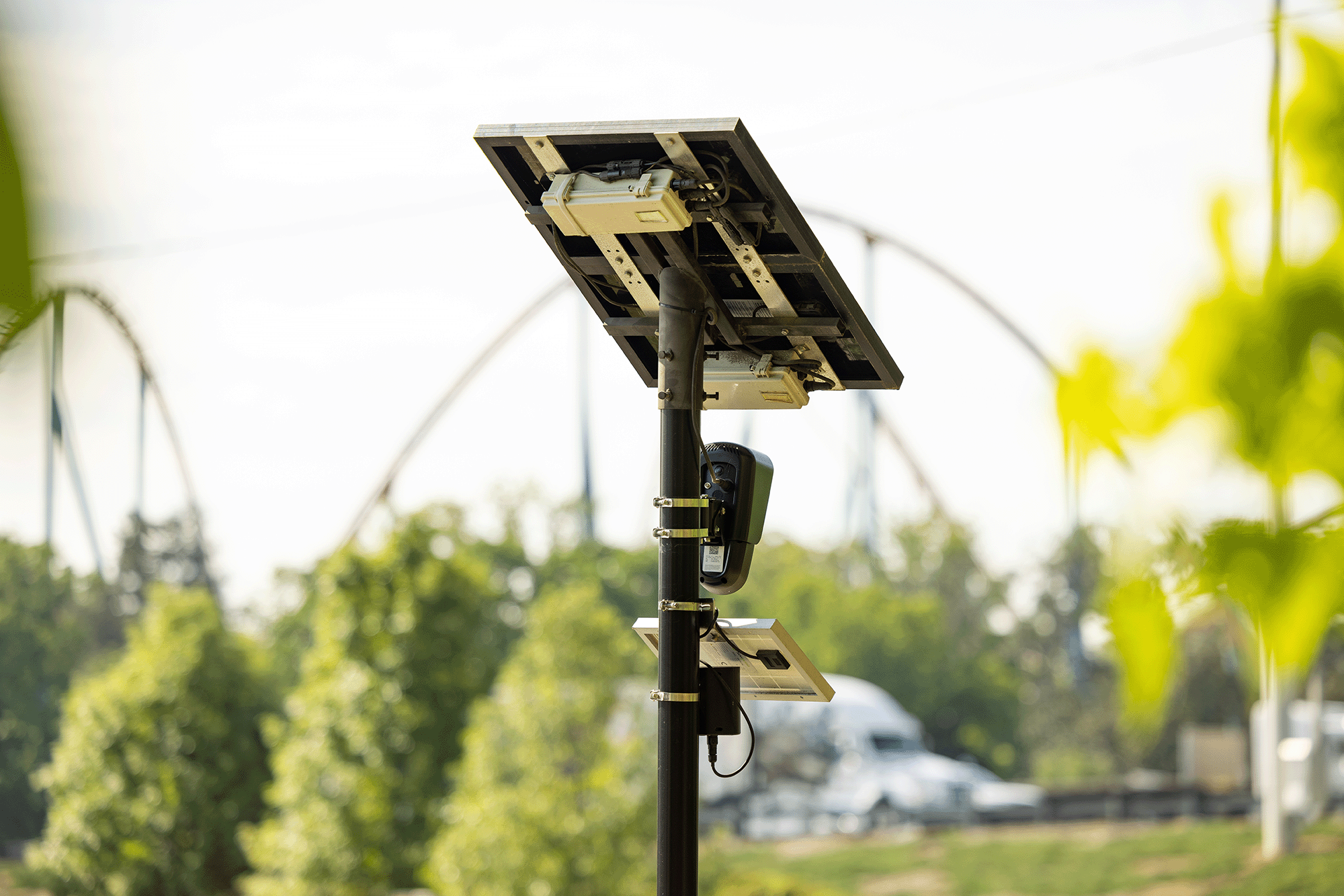
Maybe it’s just social media, which we all know is a sort of a parallel universe, but the debate over Flock cameras, (generically known as license plate readers or LPRs,) is a hot topic. Most of the action appears to be on the anti-Flock camera front, with concerns over privacy being the topic of concern.
Full disclosure - my own time as a police officer was way before modern LPRs although their distant relatives were in very limited use. They were sometimes used during investigations when I was in the FBI, but the data came from the local police on a case by case basis.
Flock Safety is a private, Georgia-based company that is the largest supplier of LPRs to both the police and private entities. They also make video surveillance equipment, drones, and other devices as well as software that runs this equipment. You can review their comprehensive web site here. There are several other big name contractors who manufacture LPRs including Motorola (the radio company,) and Axon, (the body cam and taser company,) but Flock is the big dog.
What do they do: LPRs RLPs. I’m kidding sort of - they basically just read license plates. At least that what the original LPRs did. They also capture the vehicle related details such as make, body style, color, an other characteristic like trim, roof racks, etc. “Some” of this is through DMV records, more below on that.
What don’t they do: Significantly, they don’t capture facial images and they do not do facial recognition, which is a huge misnomer, especially in the so-called “deflock” movement. More on them below too. They also are not used for traffic enforcement like speeding, red light running, or toll collection. Those are completely different systems, and a different, (though maybe related) debate.
Personally, for reasons I’ll describe, I support the supervised and audited use of LPRs, and I don’t not support traffic enforcement cameras. I’ve seen the sausage made with the latter and for the most part, they are revenue generating machines, owned and run by private companies, with a nod and a wink to law enforcement. Fodder for a separate article.
LPRs are not exclusively used by law enforcement, though that seems to be the biggest area of concern. Some 5000 law enforcement agencies employ them, along with 6000 communities and 1000 businesses. The latter two use them for security of their facilities including preventing theft and identifying persons who are prohibited from being on a property. Going forward, I’m generally taking about the law enforcement use.
How they work: At the simplest level, police deploy X number of the LPRs at strategic locations around their jurisdictions. It’s usually at the entrance points into the city/county, as well as in areas with crime problems. When a vehicle that has been entered into a data base hits the camera, police are notified of the information and location. Usually, these vehicles are stolen, driven by wanted persons, missing persons, or of interest in other legitimate law enforcement investigations. The cost is approximately $2500 per camera per year.
What data base?: It gets complicated from here. Rule number one is that individual clients, the police departments in this example, owns the decision about what goes into the data base and they own the data. It can be unique to that jurisdiction, or can include neighboring and other jurisdictions. These are individual decisions by individual jurisdictions. Many/most jurisdictions include NCIC (National Crime Information Center) data that includes wanted and missing persons and stolen property. What level of decision-making happens about what data is included, varies too. Some jurisdictions might allow the chief or sheriff to unilaterally run the systems, others might have additional civilian oversight.
How they don’t work: LPRs don’t track your vehicle, per se. It hits the camera and there is not another hit unless/until you hit another camera. Now, cops aren't stupid. They’ve know since way before LPRs how criminals traverse their jurisdiction. If it looks like a wanted person or stolen car is headed out of town, or toward an interstate, they head that way, and did so pre-Flock. When you hear about a crime on the news and how police spotted the vehicle, this together with Flock, is often how. According to Flock Safety, LPRs are responsible for helping solve 20% of crime across all jurisdictions where they are deployed. In some areas with high crime, it’s much more. They claim 10,000 missing persons were recovered last years. You can see those claims here.
About AI: Artificial Intelligence or AI is the fastest way to make a boogeyman out of any discussion. Yes, depending on how it’s used, AI can be a threat to privacy. But I think people discount how AI has been used in many areas of their lives for years, and not in a negative manner. Google, spellcheck, Spotify playlists, etc. are all early versions of AI before we called it AI.
Law enforcement agencies can employ AI with Flock LPRs and other products. Often this is by integrating 911 data, investigative information and other holdings into the system. If you want to go deep on this, you can read about their software products here . But as always, the client, (police department in the example,) controls what goes in and how it’s used. The default setting for keeping data in Flock in thirty days, although departments can adjust that.
Privacy Concerns: This is the sticky wicket for many people. They envision LPRs as an invasion of privacy, tracking them and everything they do, and I’ve seen articles claiming they violate both the Fourth and Fifth Amendments to the Constitution. I think that is nonsense. Every state requires you to have a license plate that belongs to the state, to operate a vehicle on state roads. The ACLU, not surprisingly, has taken a strong stand against the use of LPRs and you can read their arguments here if you want.
Some departments, driven by privacy concerns have stopped the use of LPRs. These are mostly in left leaning cities like Los Angeles, Eugene, Austin, and Denver. Other cities specifically note on their web sites that LPRs are not used for immigration enforcement. Currently, ICE is not a client of Flock.
A “deflock movement” of anti-LPR activists has sprung up where they engage in deflock days of action, and some even condone violence by encouraging their followers to destroy cameras when the see them. This is reminiscent of the Earth Liberation Front (ELF) movement twenty years ago where activists engaged in the destruction of heavy equipment to protest development. There is crossover between the deflockers, and some, (not all) of the anti-data center activists.
Ironically, many of these activists, and even people merely concerned about privacy don’t realize there is far more data about what they are doing and where being captured by that little computer in their pockets. Or in who their ISP and even their state DMVs are selling their personal information to.
Oversight: The answer to privacy concerns with almost any government use of technology is oversight and strong audits. For decades, a few law enforcement officers misused DMV data bases to run personal information about their girlfriends or even alert criminals that they were wanted. Way before LPRs came along. That didn’t mean we stopped using DMV and NCIC data. It means punishing officers who abuse their authority. Same thing here. Almost every negative news story about Flock cameras will mention the same two stories; A Kansas police officer who stalked his wife, and a Colorado officer who arrested the wrong person based on LPR data.
The answer is to use the strong audit features in Flock and to punish, and when called for, prosecute law enforcement personnel who misuse these systems for non law enforcement purposes.
What I’m Working On:
I’ve finally finished everything I can do on GRAY GHOST; An Air America - CIA Thriller, and I should have advanced reader copies any day, so I’ll finally get to see what it looks like in person! I wrote in the Author’s Note how this was a much harder book for me to write because it did not involve lived experiences, and the story takes place nearly 60 years ago. So there was a lot of research on the topic, as well as to make sure everything I wrote about existed (like the Boeing 707) or didn’t exist, (like cell phones. Okay - that’s a weak example.) Read all about it, and pre-order here.
I teased last week I’ve started the outlining and planing on my first non-fiction book about the January 5th Pipe Bomb case, an investigation that went unsolved for five years. And now there is all kinds of drama about the subject who was arrested, and an alternate subject who the conspiracy industrial complex believes did it. (One bit of evidence against the subject arrested was LPR data.) Stay tuned for updates on that.
Also, that super secret project I keep teasing. Still can’t say, except you will see why when I can say.
And a novella (details soon,) and a couple of short stories. And a diving trip to the Keys in August.
Regards,
F.X.

Great info! I was wondering what all the flock was about. LOL