

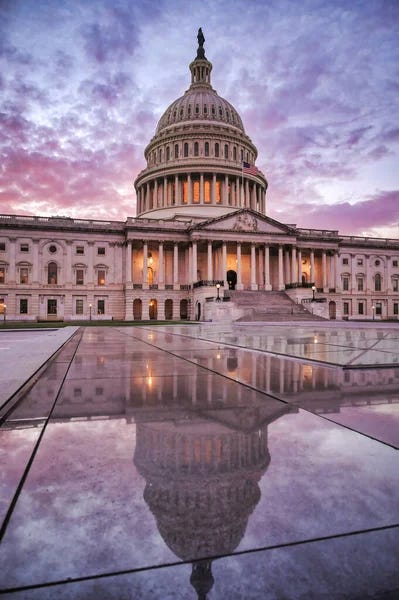
The three-year anniversary of the events of January 6th, 2021, at the U.S. Capitol along with a recently filed federal lawsuit, have revived the controversy about the shooting death of Ashli Babbitt by U.S. Capitol Police Lieutenant Michael Byrd on that historic day. The shooting is filled with emotion and includes extraneous factors like pro and anti-President Donald Trump sentiment, discussions over whether the events of January 6th constituted an insurrection or an unlawful assembly/trespassing, and the race of the both the officer involved in the shooting, Lt. Byrd, and Ms. Babbitt. Importantly to me, and the focus of this article, are considerations on the use of deadly force by Capitol Police that day.
I won’t go over my entire background which can be viewed on my website or in other Substack articles, but briefly, I was a local police officer in a major metropolitan police department, and then an FBI special agent for a combined more than thirty-two years. During that time, I received significant training on the use of deadly force at three different law enforcement academies as well as at every firearms recertification session which occurred approximately four times a year over those years. Almost every in-service I attended during my time at the FBI included a short block of instruction on the use of deadly force. I estimate I have heard instructions on the use of deadly force by law enforcement officers and special agents at least one-hundred-fifty times during my career. Since retiring from law enforcement, I continue to receive annual training and I qualify to carry a firearm under the Federal Law Enforcement Officers Safety Act.
Additionally, from 2005 to 2008 I was a senior executive at FBI headquarters where one of my duties was as a member of the FBI Director’s Shooting Incident Review Group, (SIRG). In my responsibilities on the SIRG, I reviewed every discharge of a weapon by FBI special agents that occurred outside of the training environment. I estimate that I and fellow agents on the SIRG reviewed more than one-hundred shooting incidents, some of which were accidental discharges of a weapon. Tragically, three of the shooting incidents I reviewed involved the deaths of fellow FBI special agents. Also, when I was a supervisor, and then when I was the special agent in charge of an FBI field office, I responded to agent-involved shootings where I was the on-scene commander responsible for the initial shooting investigation.
In the aftermath of an FBI shooting, the protocol was that an independent Inspection team deployed from FBIHQ to the field to review the facts surrounding the shooting. During my time in the FBI, I was also designated an Assistant Inspector in Place and responded to agent-involved shootings and was involved in these shooting investigations. The Inspection team formed no opinions and made no recommendations. When their report was complete, they provided their findings to the SIRG, who, after deliberation, made recommendations to the Director about what, if anything, should happen as a result of an agent-involved shooting incident. Some of the results were pro-forma. For example, at the time, if an FBI agent accidently discharged a weapon under any circumstances, it resulted in an automatic three-day suspension without pay.
I disagreed with this zero-tolerance policy because there were examples where, for example, an agent discharged a firearm into a corkboard or barrel in a gun cleaning room which was designed to make sure a firearm was safe and empty. (Glock handguns that were carried by the FBI agents at the time, required the trigger to be pulled before the gun could be disassembled, hence the wall or barrel where agents were to clear the weapon and then pull the trigger.) I disagreed with this policy because I believed it discouraged agents from self-reporting accidental discharges, which could have been used for analysis and training. I was overruled on my position on this issue and during my time on the SIRG, agents were given this three-day suspension.
The Use of Deadly Force
The FBI’s deadly force police at the time I served, which is unchanged today, is:
Special agents are authorized to use deadly force when they reasonably believe that they, or another individual, is in imminent threat of death or grievous bodily harm. https://www.fbi.gov/about/faqs/what-is-the-fbis-policy-on-the-use-of-deadly-force-by-its-special-agents.
Most, but not all law enforcement agencies have a very similar policy. The International Association of Chiefs of Police (IACP) has a model use of deadly force policy that is similar but contains two exceptions not included in the FBI policy. One exception allows for the use of deadly force of a fleeing individual if the individual can be described as an imminent threat. https://www.theiacp.org/sites/default/files/2020-07/National_Consensus_Policy_On_Use_Of_Force%2007102020%20v3.pdf. The FBI policy does not state that specifically, but it doesn’t specifically prohibit it either, if it fits into the parameters of the stated policy. (For example, an armed fleeing subject who is moving toward another special agent or innocent person who might then be at imminent risk.)
The IACP model policy also allows for the use of warning shots if they can be safely employed, which the FBI policy does not include. In fact, the FBI policy specifically prohibits warning shots. The U.S. Capitol Police use of force policy is similar to most use of deadly force policies, and specifically mentions authorizing the employment of deadly force on a fleeing individual if they are reasonably believed to be an imminent threat. https://www.gao.gov/assets/gao-22-104829.pdf.
Ashli Babbitt
I won’t go into too much detail on the two main actors in this scenario, but briefly Ashli Babbitt was a thirty-six-year-old white female Air Force veteran, having served in the military for fourteen years. She was married and lived in California with her husband where they owned a pool service company. She was a supporter of President Trump, and traveled to Washington, D.C. on January 5th to attend a rally on the ellipse on January 6, 2021. She then joined a crowd of others who marched to the Capitol to protest the certification of electors which she and others believed were a result of faulty election procedures on/after November 3, 2020. After making entry to the Capitol on the Senate side, she was directed to a hallway by a female Capitol police officer which led to the Speakers Lobby. While standing outside the double doors to the Speakers Lobby, she was shot and killed by Capitol Police Lieutenant Michael Byrd. Additional details are contained in below sections.
Lt. Michael Byrd
Not many facts about Lt. Byrd are known, and unlike in the case of Ms. Babbitt, the media has shown little curiosity in uncovering further details. We know he was a black male, twenty-eight-year veteran of the department that day and was in command of the officers inside the House. In fact, he was the designated Incident Commander operating under the National Incident Management System (NIMS), making him an important person in a position of leadership. Lt. Byrd had a history of disciplinary issues that may be relevant to his decision to fire his weapon that day that I will address below.
In a highly unusual move in law enforcement shooting investigations, Byrd’s name was never released after the shooting. In fact, The Department of Justice cleared Byrd of any potential federal civil rights criminal violations in April of 2021 without naming him. https://www.justice.gov/usao-dc/pr/department-justice-closes-investigation-death-ashli-babbitt.
On August 21, 2021, The Capitol Police cleared Byrd of any violations of department regulations, again without naming him. https://www.uscp.gov/media-center/press-releases/uscp-completes-internal-investigation-january-6-officer-involved. On August 26th, Byrd identified himself in an interview with NBC, and claimed he was doing so as a result of threats to him that were documented in an FBI threat assessment. Byrd’s attorneys claimed that unscrupulous sources were about to identify Byrd, although none of these sources have been identified, nor (to my knowledge,) has the FBI threat assessment, or any evidence of threats to Byrd, been made public.
I would not claim that this has never happened before, but I don’t recall, nor could I find another example of where a police officer who was involved in a use deadly of force incident, had their identity kept confidential until they disclosed it themselves nearly ten months later. Usually, within days, including in other high-profile incidents that involved racial factors, as this one did, an officer is officially identified at some point by their department, prosecutors, and/or officials of the jurisdiction they serve.
The Shooting
I have not seen the details of either the DOJ investigation that cleared Byrd of federal civil rights charges, or the internal investigation (that was conducted by the D.C. Metropolitan Police Department’s Internal Affairs Division,) that lead to him being cleared of any department violations. (I have only seen the announcements.) Much of my analysis comes from the federal wrongful death complaint filed by the Estate of Ashli Babbitt against the United States of America, and other documents that are hyperlinked in this article. I presume many of the facts in the complaint are accurate because they include transcripts of radio transmissions, and quotes from official investigative reports. I presume Babbitt’s Estate attorneys have seen these primary documents. I’ll note however that I have seen some reporting and witnesses reports in the media that sometimes conflict with the accounts contained in the complaint. Additionally, I watched Lt. Michael Byrd’s’ interview with Lester Holt on NBC from 2021, so I know what he said. https://www.cnbc.com/2021/08/26/capitol-cop-who-shot-pro-trump-rioter-ashli-babbitt-comes-forward.html.
According to the Plaintiff’s Complaint, Lt. Byrd, who was in plain clothes, and several other armed Capitol police officers were behind a door to the Speakers Lobby in the Capitol at approximately 2:44 p.m. on January 6, 2021. According to the Plaintiff’s Complaint, there were no Congresspersons in the Speakers Lobby being protected at the time. Shortly before 2:44 p.m., three additional armed Capitol police officers were on the other side of the door to the Speakers Lobby protecting it. A crowd that varied from fifteen to eighty people, depending on which witness is reporting, approached the door.
Lt. Byrd would later describe the crowd as “hundreds of people.” Byrd would also later erroneously claim there were sixty to eighty other people in the House Chamber, when in fact there were only six, all of whom decided to stay there when others were evacuated, and they were being guarded by armed officers. Shortly before 2:44 p.m., the three Capitol police officers abandoned their position in front of the double doors and retreated to a position along a wall to the side of the protesters.
Reports are that several of the protesters, but not Babbitt, broke out the two windows in the double doors leading to the Speakers Lobby. There are reports that Babbitt attempted to enter the Speakers Lobby through one of the broken-out widow openings, when she was shot by Lt. Byrd. The Plaintiff’s Complaint says that Babbitt raised herself into the opening but stops short of saying she was attempting enter. The complaint claims that Byrd, who was not in uniform, did not identify himself as a law enforcement officer, nor did he warn her not to enter, or give her any other commands before firing.
One minute later, after the shooting, at 2:45 p.m., Lt. Byrd announced over his department radio; “405B. We got shots fired in the lobby. We got shots fired in the lobby of the House chamber. Shots are being fired at us and we’re sh, uhh, prepared to fire back at them. We have guns drawn. Please don’t leave that end. Don’t leave that end.”
Approximately 35 seconds later, Lt. Byrd made another radio call, stating, “405B. We got an injured person. I believe that person was shot.” https://www.judicialwatch.org/wp-content/uploads/2024/01/Estate-of-Ashli-Babbitt-and-Arron-Babbitt-et-al.-v.-U.S.A-1.pdf.
As I will discuss below, these radio transmissions by Byrd are extremely problematic.
Shortly before the shooting, a CERT (a specialized tactical team) was making their way toward the crowd and were nearly to them when Lt. Byrd fired the shot that struck Babbitt from his position behind the door, into the broken-out widow opening. Officers who were outside the doors, (on the other side,) earlier reported that there was no way Babbitt could have seen Lt. Byrd from her position.
Analysis
The crux of this article is the justifiable use of deadly force by law enforcement officers, not a legal analysis of the shooting death of Ashli Babbitt, which I am not qualified to present. There are several good legal analyses of the events available, and I recommend this one by Lawfare Media. Since everything is looked at through the lens of politics today, I think it is accurate to note and describe Lawfare as slightly left of center. https://www.lawfaremedia.org/article/evaluating-police-shooting-ashli-babbitt.
Having said this isn’t legal analysis, there are a few important legal points to make. First, every law enforcement shooting that does not result in criminal prosecution of the officer, is not a de facto “good shoot,” i.e. “justified.” There are many examples of officers who were found to have not been justified in their use deadly force who were not prosecuted for crimes. Many of them, but not all, were disciplined and/or fired. There are other examples where the department, union, citizens, or other interest groups thought an officer was justified using deadly force, and prosecutors saw it differently.
There is another category of accidental shootings which may or may not lead to prosecution. A recent example is Kim Potter of Brooklyn Center, Minnesota, who clearly accidentally shot Daunte Wright, (accidental by virtue of her shouting “taser, taser, taser, before shooting him with her firearm, not her taser.) Even though Mr. Wright had just committed a domestic assault and had a knife in his vehicle at the time. https://www.cnn.com/2021/12/23/us/kim-potter-trial-thursday/index.html.
Potter was convicted of manslaughter and sentenced to two years in prison.
It is important to note that the District of Columbia is unlike other jurisdictions in the country in that the United States Attorney’s Office (USAO) for the District of Columbia prosecutes felony charges. In the case of Lt. Byrd, the DOJ announcement that he would not be prosecuted was a joint USAO – DOJ Civil Rights Division statement. It said, “The U.S. Department of Justice will not pursue criminal charges against the U.S. Capitol Police officer involved in the fatal shooting of 35-year-old Ashli Babbitt.” The statement goes on to describe 18 U.S.C., Section 242 which is the statute that defines violations of a person’s civil rights, including law enforcement officers under color of law.
The statement concluded saying, “The investigation revealed no evidence to establish beyond a reasonable doubt that the officer willfully committed a violation of 18 U.S.C. § 242.” Nowhere in the statement is there a reference to the homicide or manslaughter statutes of the District of Columbia, which are prosecuted under the authority of the same USAO. It is unreasonable to believe that during the three-month DOJ investigation, there was no discussion of the possibility of charging Lt. Byrd with murder or manslaughter, yet the potential for those charges, and why they don’t apply are not described in the statement.
And now to the narrower issue of the justifiable use of deadly force. Keep in mind the standard is not exactly what the officer saw, perceived, and did, per se; it is what a reasonable law enforcement officer would do given the same set of circumstances. A classic example of this is an officer who shoots a subject when the subject disregards his commands to not move and pulls something out of his pocket that the officer perceives to be a gun. If it was cell phone, and the officer could have reasonably perceived it to be a gun in the fraction of a second he first saw it before he shot, it might be a justified shooting. If it was a paperclip, which the officer should not have reasonably perceived to be a gun, it might be an unjustified shooting. Don’t lock in on these as concrete examples since there could be way more factors we are not considering in each example.
In the case of Lt. Byrd, the only question is “would a reasonable police officer in the same situation as Lt. Byrd employ the use of deadly force against Ashli Babbitt?” Lt. Byrd was approximately fifteen feet to Babbitt’s left, behind a wall he appeared in a video to be using for cover or concealment. Babbitt was behind the locked double doors which had been further barricaded from the inside (the side Byrd was on,) with heavy furniture. Byrd’s weapon can be seen in the video in his right hand only, pointed at the doors for a period of seconds before he shot.
Byrd claimed in the NBC interview he was taking a tactical position. During my thirty-two years of law enforcement firearms training, I was never taught that one-handed shooting was a preferred or tactical technique when firing a weapon. One handed shooting was a default technique when the other weak or strong-side hand was injured or incapacitated.
Byrd admitted in the NBC interview that he could not see Babbitt’s hands at the time he shot her and only learned hours later she was unarmed. In fact, he admitted he could not even tell if she was a man or a woman. To my knowledge, no law enforcement officer has ever been killed or grievously injured by a subject who used anything but his or her hands to murder or injure the officer. So, it appears that at the moment Lt. Byrd fired his weapon at Babbitt, she could not have been an imminent threat to him or anybody else.
Because of the way the double doors were locked and barricaded, the only way to breach the Speakers Lobby was through the broken windows, one or two persons at a time, as it appears Babbitt was attempting to do. I have seen nothing to explain why, had Babbitt successfully breached the Speakers Lobby through the broken window, she could not have been verbally commanded to stop, been subject to less than lethal force such as a taser, baton, pepper spray or tear gas, or physically restrained by Byrd and the other armed officers who were with him. In fact, the Capitol police directives on use of force requires officers to go through this exact continuum of force protocol before deciding to use lethal force.
An important point of consideration when deciding to employ deadly force is called “backdrop.” The area in the foreground, background, and near proximity of the target that might be hit with a round dispatched from a firearm. In my opinion, since Lt. Byrd said he believed there were hundreds of other individuals in the hallway on the other side of the doors of the Speakers Lobby, he showed extremely poor judgement shooting into the crowd, even if he was specifically aiming at an individual that he said he could not tell was a man or a woman. I don’t believe Lt. Byrd could have had the requisite confidence that even a perfectly placed round would not have penetrated Babbitt and passed into the hundreds of individuals he thought were on the other side of the door.
As an incident commander, Lt. Byrd had a special duty to know where other law enforcement officers under his command were at all times. This includes the three officers who were on the other side of the door from him just moments before he fired, and the four CERT officers who were making their way into the crowd toward his fired round.
In a section above I quoted Lt. Byrd’s radio transmissions and described them as problematic. Here is why: First, his broadcast that shots had been fired came after he had already fired the fatal shot at Babbitt. Instead of advising that he had just been involved in a shooting, his broadcast is in the third person, as if other individuals were shooting at them. In fact, the only shots fired that day at the U.S. Capitol were by Lt. Byrd. He said, “Shots are being fired at us and we’re sh, uhh, prepared to fire back at them.” It’s not unreasonable to conclude that Lt. Bryd started to say “we’re shooting,” or “we’re firing back at them.” At which point he stopped and corrected himself to say they were “prepared to fire back at them,” because he knew he was the only individual who had fired a shot.
His next radio transmission 35 seconds later is, “405B. We got an injured person. I believe that person was shot.” This is disingenuous at best, and a false statement at worst. “I believe that person was shot,” is a much different statement than the more accurate, “I just shot that person,” which is what Lt. Byrd had to know is what just happened. Both of these statements go to Lt. Byrd’s state of mind. If he was as confident that he properly used deadly force against Babbitt as he portrayed nine months later in a scripted media interview, why in real time did he try to distance himself about what he had just done? My opinion is he knew right away the shooting was problematic.
Lt. Byrd’s History with Firearms Incidents
During a twenty-eight-year career in law enforcement, nearly every officer makes mistakes. It happens. They disrespect a citizen, wreck a car, engage in shoddy documentation of their work, and any number of other department infractions. While we don’t know Lt. Byrd’s complete disciplinary history, we know of three incidents involving firearms. The most well-documented one which he himself addressed in the NBC interview involved leaving his firearm in a visitor’s restroom for several hours until it was discovered by another police officer. Hundreds of visitors potentially had access to the weapon.
A less well-documented incident that I have only seen twice, once in the Plaintiff’s Complaint and once in the media, is more serious, and involved Lt. Byrd firing his weapon, off duty, into a vehicle occupied by unarmed juveniles. Apparently, Lt. Byrd was the victim of his car being stolen and he fired at the juveniles in an attempt to stop them. Some of the rounds he fired struck nearby houses. Lt. Byrd’s police powers were suspended for a time after this incident.
Lt. Byrd’s police powers were also suspended in the past when he failed to qualify, (or attend - the details are not clear,) semi-annual firearms training sessions as required by policy. While previous bad behavior doesn’t make an individual guilty of a future event, these incidents involving firearms are extremely serious and potentially relevant toward Lt. Byrd’s judgement in employing the use of deadly force in this law enforcement encounter.
Conclusions
Based on my training and experience as a law enforcement officer for 32 years, including as an Assistant Inspector in Place who investigated use of deadly force incidents by FBI agents, my experience as a supervisor, and as special agent in charge of a field office where I completed the initial phases of FBI agent shootings, and my experience on the Director’s SIRG adjudicating FBI special agent shootings, I do not believe Lt. Michael Byrd’s use of deadly force against Ashli Babbitt was justified. I believe that in virtually any other setting except the hyper charged atmosphere of the events of January 6, 2021, any law enforcement officer who used deadly force in the same manner that Lt. Byrd did that day could expect to have been disciplined up to including termination, and potentially prosecuted for murder or manslaughter.
Usually at the end of these newsletters I usually conclude with lighthearted fare about what I’m reading, watching on TV, listing to in music, and I engage in self-promotion about my fiction books. This topic seems far too serious to end that way so I will leave that to next time.
F.X.
Outstanding write up. It’s really interesting all the firearms history from the LT involved.
I thought there had to be way more to this story. As a retired LEO and trainer, I too thought this incident was strange because of the circumstances surrounding it and the use of deadly force with other people in the background. Appreciate the great details and insight.
Outstanding analysis! Will share!